
Vannia Yalan is a staff writer and second-year MPA student.
When I arrived in Amsterdam for the Youth Vision Assembly, I expected a conference about policy; what I found instead was a conversation about power dynamics and representation. Over several days of dialogue and debate, young leaders from across the globe gathered to explore how youth can move from being consulted to being co-creators in policymaking. I listened to stories from youth advocates working in vastly different contexts, from African cities facing climate migration to European regions balancing energy transition with social equity. Still, what united us wasn’t a single agenda but a shared conviction that youth participation is a structural necessity rather than symbolic inclusion.
Youth Collaboration and Co-creation
Beyond the symbolic exchange of ideas, assemblies act as mirrors that allow us to see our own communities more clearly through the lens of others. They cultivate cross-cultural understanding and transform shared uncertainty into collaborative purpose. In today’s interconnected policy environment, international dialogue among youth leaders has become a cornerstone of effective governance and innovation. For many emerging professionals, global collaboration offers both exposure and reflection as it introduces us to new approaches abroad, while challenging us to reconsider how our institutions function at home.
As a delegate from Latin America, I was particularly struck by the parallels between European and Peruvian experiences. In both contexts, civic participation is strongest when policy initiatives are anchored in lived realities, where dialogue between government and youth is continuous, not episodic. Showing that, when applied thoughtfully, global dialogue can strengthen local policymaking with greater resilience, inclusion, and sustainability.
I didn’t solely observe what works elsewhere or what fails; I recognized actionable patterns in how communities leverage participation to address structural challenges. In the Netherlands, for example, I saw how youth councils embedded within municipal governments create continuous feedback loops between young constituents and policymakers. In Peru, by contrast, creativity and inequality coexist, and policy innovation often arises not from resources but from resilience; through grassroots organizing and community-led initiatives that fill gaps left by formal institutions. These contrasting approaches revealed a common principle where effective youth engagement requires both institutional scaffolding and grassroots energy.
At a time when global governance faces declining public trust and widening generational divides, the Assembly offered something rare: not just ideas, but genuine dialogue. By bringing together over 100 young delegates from fields of policy, law, and science, it sought to redesign how the next generation participates in shaping the world’s future. Viewed this way, international assemblies do more than broaden perspective; they sharpen it. They help us reimagine local policymaking with greater adaptability, inclusion, and empathy, ensuring that international cooperation translates into meaningful national progress.
Bridging the Generational Gap in Global Decision-Making
The Assembly opened by recognizing that many of today’s global frameworks, while ambitious, were designed in contexts that often prelude the digital realities and social dynamics that shape youth lives today. The Organization for Economic Co-operation and Development, OECD’s Governance for Youth, Trust, and Intergenerational Justice Report found that only a minority of countries have put in place comprehensive, whole-of-government strategies and institutional arrangements to systematically mainstream youth participation and intergenerational fairness. Its comparative assessment covered 42 national governments and the European Union, and highlighted large variation in the legal frameworks, co-ordination mechanisms, and tools available to engage young people. Hence, during the conference, we emphasized that policies on climate adaptation, migration, and digital inclusion need to move beyond episodic consultation and toward institutionalized co-design. This conclusion echoed the OECD Youthwise work and in UN analyses of youth participation, which similarly promote youth engagement in policy to balance representation and systemic mechanisms that efficiently translate consultation into sustained influence.
From Consultation to Co-Creation
Between coffee and workshops on participatory governance, we explore how young people can meaningfully shape national and local policymaking through more inclusive institutional design. One of the most compelling examples was the Youth Advisory Boards implemented in several European ministries. These boards give young people direct access to policy discussions before legislative drafting, allowing their perspectives to influence decisions from the outset rather than simply react to them; all built around ownership, innovation and early involvement in policy formulation.
Yet, as much as these examples inspire, the Assembly also revealed a familiar frustration about how youth engagement often stops at consultation. Speaking with delegates from diverse professions, backgrounds, and experiences, our unanimous agreement was that there is a necessity to create spaces where young people are co‑creators, not just advisors. It’s not enough to listen; the system must allow us to actively shape the process itself.
After debriefs, and some needed social breaks, we concluded that impactful engagement embeds co‑creation into policymaking with a structured collaboration between youth, civil servants, and technical experts; where young people are partners in designing, implementing, and monitoring policy outcomes.
In this context, the United Nations Development Program’s Youth Strategy (2024–2030) offers a valuable framework that emphasizes youth‑led accountability systems to monitor development outcomes and ensure policies reflect young people’s priorities. Beyond consultation, the strategy underscores the importance of institutional reforms, such as establishing youth quotas in legislative bodies, creating dedicated youth budget lines within government agencies, and mandating youth impact assessments for major policy initiatives, that empower youth to influence both policy content and the structures that sustain it. These mechanisms transform youth participation from an optional add-on to a structural requirement.
In short, the shift from consultation to co‑creation is a procedural and cultural change. And if our caffeine‑fueled discussions at the Assembly taught me anything, it’s that when young people are genuinely empowered to co‑create, policy becomes more inclusive, relevant, and resilient.
Translating Lived Experience into Policy Design
The Assembly’s thematic discussions on climate resilience, digital inclusion, and economic opportunities underscored how personal experiences can shape public policy. Delegates from the Global South spoke about how informal labor, environmental displacement, and educational inequality continue to hinder youth empowerment. For instance, in many developing countries the informal economy remains the dominant form of employment for youth, studies in Sub‑Saharan Africa show that between 80 % and 95 % of youth engage in informal jobs.
Another recurring theme was that policy legitimacy is not built in boardrooms, but in communities because legitimacy depends on policies making sense in and through the lived realities of people, not solely through expert‑driven processes. Programs designed without the input of affected populations risk failing, regardless of how well‑funded or technically sound they are. By connecting personal stories with institutional mechanisms, the Assembly’s discussions challenged us to rethink how expertise is defined and valued. This resonates with sociologist Amitai Etzioni’s concept of the Active Society, in which society’s governance should balance administrative capacity with participatory energy.
For governments, the challenge is to transform participation from a reactive process into a proactive component of policy evaluation and delivery. And it was clear that bringing youth into that proactive process links directly back to the co‑creation imperative we described earlier.
Institutional Pathways for a Youth-Inclusive Future
As the Assembly closed, we agreed that youth empowerment requires institutional redesign. In our policy framework design, three ideas stood as pillars for a cohesive and comprehensive action plan:
- Creating youth focal points within ministries of finance, environment, and technology to integrate generational perspectives into core policymaking.
- Institutionalizing youth consultation frameworks in multilateral organizations, particularly within development finance and sustainability programs.
- Leveraging digital tools to expand civic participation, such as e-consultation platforms that allow real-time feedback on government programs.
These initiatives reflect an understanding that institutional inertia, not lack of talent or interest, is the main barrier to youth engagement. In other words, the structures that govern policy often exclude youth by design or by default, which means the barrier is systemic rather than individual. As public trust becomes increasingly fragile, redefining participation becomes not only a democratic ideal, but a governance imperative.
Hearing, engaging and learning from global youth advocates was a valuable opportunity to explore the complex scenario our societies face. The Youth Vision Assembly reminded me that the answer lies not in waiting for inclusion, but in co-designing the institutions of the future. Ones that reflect the diversity, resilience, and creativity of a new generation ready to serve. From Lima to Amsterdam, and from America to Asia, young leaders are asking the same fundamental question: How do we rebuild trust in systems that were not built for us, but must now be led by us?
In a world where decisions are often made faster than citizens can react, youth involvement reintroduces moral and social grounding to policymaking. By integrating youth voices into formal systems, whether through advisory mechanisms, co-creation spaces, or evaluation processes, governments can ensure that their policies reflect not only fiscal or political efficiency but human purpose. Indeed, the Assembly’s message was clear on how policy relevance is sustained when governments and institutions listen to youth-shaped input.
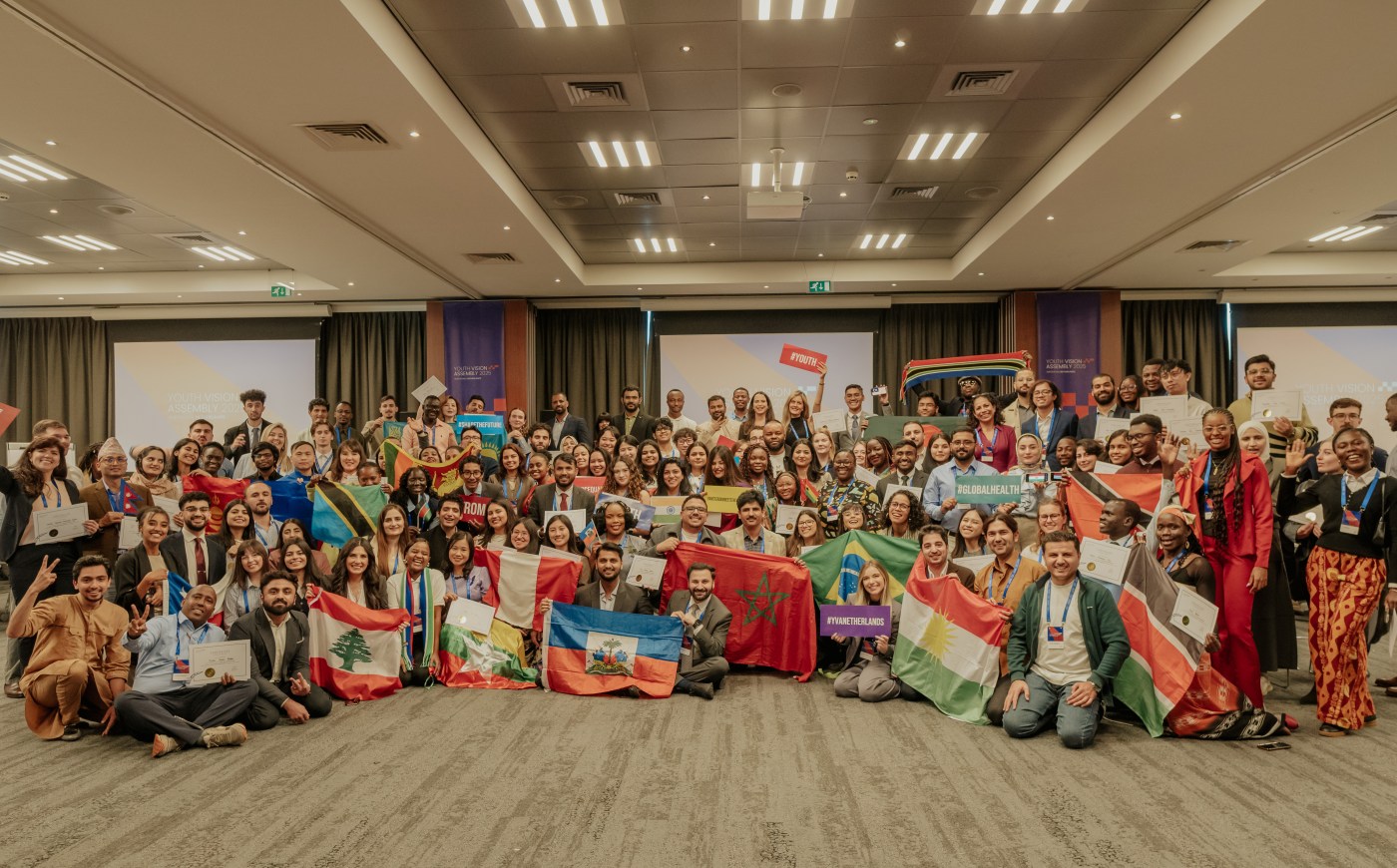
Photos by Vannia Yalan
The views expressed in Policy Perspectives and Brief Policy Perspectives are those of the authors and do not represent the approval or endorsement of the Trachtenberg School of Public Policy and Public Administration, the George Washington University, or any employee of either institution.
 Policy Perspectives