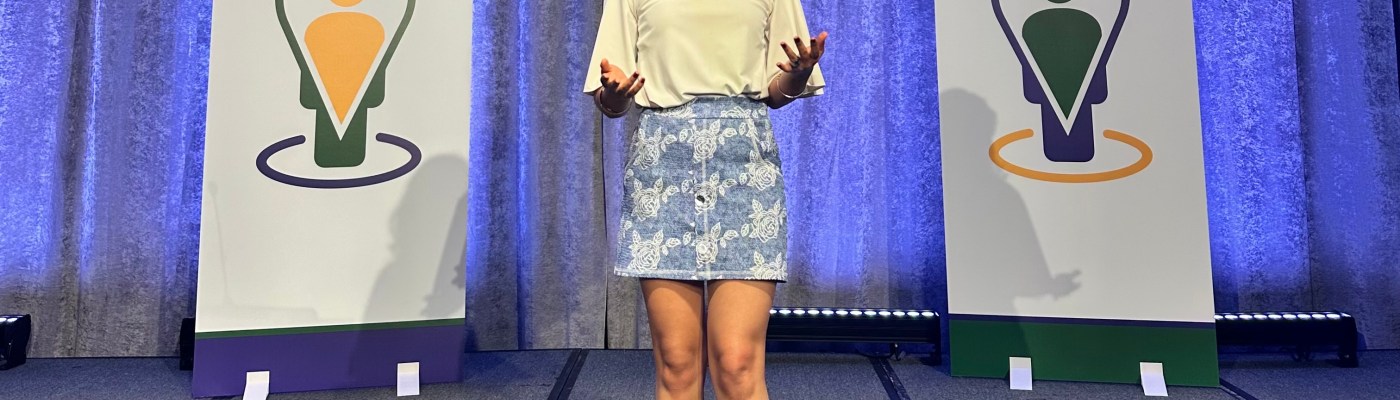
Vannia Yalan is a staff writer and second-year MPA student.
Place is more than geography: it is identity, opportunity, and belonging. This conviction was fiercely reinforced at the People and Places Conference hosted by five national community development organizations: Community Opportunity Alliance, National CAPACD, National Urban League, Black Community Developers Group, and NALCAB.
Through the collaboration between the Trachtenberg School of Public Policy and Public Administration and the Community Opportunity Alliance, I joined national policymakers, scholars, and civic leaders to explore how public policy can address inequality, not just through redistributing resources, but by transforming the environments that shape people’s daily lives. In fact, the conference emphasized how public policy success is inseparable from the place, the space where communities live, work, and connect.
The importance of place and belonging resonated deeply with me. Born in Lima, raised in Iquitos in the Peruvian Amazon, and later educated in Vancouver and Washington, DC, I have lived the contrasts that geography, culture, and politics create. These experiences taught me that while challenges may differ, from the urban density of Lima to the riverine isolation of Iquitos, the social aspirations usually surround similar values of safety, dignity, and community. The same pillars we covered throughout the conference as the foundations to be public servants under shared humanity.
Understanding Place-Based Policy
The conference highlighted the growing relevance of place-based approaches, which prioritize localized strategies over uniform national solutions. As Joyce Pisnanont, Chief Strategy and Impact Officer at National CAPACD, noted, equity cannot be achieved through standardized policy, it must be contextual, participatory, and grounded in lived experience.
The conference reaffirmed that place-based policy, tailored to the distinct social, economic, and environmental realities of specific communities, is increasingly essential to equitable governance. Unlike standardized “one-size-fits-all” frameworks, place-based approaches emphasize context, participation, and local capacity-building.
Speakers continuously referenced the U.S. Department of Housing and Urban Development’s HUD’s Thriving Communities Initiative, which supports local governments in integrating housing, transportation, and economic development to create inclusive growth. Locally, in Washington DC, similar principles underpin projects like the 11th Street Bridge Park, which combines infrastructure investment with anti-displacement measures and job creation programs in historically marginalized neighborhoods. These examples demonstrate how infrastructure, when designed with intention, becomes an act of inclusion beyond a tool of efficiency.
As several panelists noted at roundtables, policy that ignores place risks reproducing inequality. When federal or national programs distribute resources uniformly, communities already facing structural disadvantages often remain underserved. In other words, the where of policy determines the who of opportunity.
When Policy Meets People
One of the most compelling ideas discussed at the conference was co-production, where citizens should be partners in designing services rather than just recipients. Co-production has been applied globally through participatory budgeting, a model pioneered in Porto Alegre, Brazil, and later adopted in Barcelona and New York City, where residents directly allocate portions of public funds to community priorities.
From these examples, it is clear that equitable outcomes are more likely to emerge when decision-making power is shared. For countries like Peru, where rural and urban disparities persist, co-production holds a special promise of bridging divides. In Iquitos, for example, community-led water management initiatives and informal education networks have long filled gaps left by limited institutional reach, demonstrating how people can build resilience from the ground up. These experiences mirror the arguments expressed at the conference, showing that policies are most effective when designed with communities, not merely for them.
Bridging Administrative and Lived Knowledge
Several panelists stressed the need to integrate administrative knowledge (data, performance metrics, institutional expertise) with lived knowledge (the insights of those who experience policy firsthand). One session drew on the OECD’s Framework for Measuring Well-Being and Progress, which encourages governments to evaluate policies for economic output, but also to examine the quality of housing, safety, social connection, and civic trust.
The idea resonated with political scientist David Rosenbloom’s reflections on Public Administration Theory and the Separation of Powers, which highlight that effective governance must balance managerial efficiency with democratic responsiveness. To achieve that balance, public administrators must listen to the people behind the data points, recognizing that statistics represent lives, not abstractions.
Infrastructure as a Moral Choice
Across panels, speakers returned to the premise that infrastructure reflects social priorities. Drawing on sociologist Eric Klinenberg’s concept of social infrastructure, participants argued that parks, libraries, and public spaces are more than amenities, they are engines and connecting venues of equity. Research from the International Journal of Environmental Research and Public Health support the argument that strong social infrastructure reduces isolation and enhances community resilience during crises. Where social infrastructure thrives, social trust grows; and where it is absent, exclusion deepens.
Infrastructure, in this sense, is moral architecture. For instance, in the Amazon, a single bridge or ferry route can determine whether farmers have access to trade routes or children can safely commute to school. Thus, policymakers should focus a bit more on for whom they build.
Governance for Belonging
The People and Places Conference ultimately redefined effective governance as relational. When we acknowledge that the where of policy determines the who of opportunity, we recognize that geography is never neutral; it either reinforces or dismantles barriers to the safety, dignity, and community that all people seek. When we design policies with communities rather than merely for them, we honor the lived knowledge that no dataset can fully capture. When we listen to the people behind the data points, we transform statistics into stories of real needs and aspirations. And when we ask not only what to build but for whom we build, we ensure that infrastructure becomes a tool of inclusion rather than exclusion.
These principles converge on a single truth: public administrators are not just implementers of policy but architects of belonging. Measuring success, therefore, requires looking beyond outputs (e.g. the number of housing units built, or dollars allocated) to the lived experiences of those served. Do people feel safer in their neighborhoods? Can they access opportunities with dignity? Are they connected to community?
Whether in Washington, Vancouver, Lima, or Iquitos, the core principle remains the same: public value begins where people live. Place-based thinking calls on us to design policy as care, not just as control. It asks us to build governance systems that recognize place as more than geography, but as identity, opportunity, and ultimately, as home.
Photo by Vannia Yalan
The views expressed in Policy Perspectives and Brief Policy Perspectives are those of the authors and do not represent the approval or endorsement of the Trachtenberg School of Public Policy and Public Administration, the George Washington University, or any employee of either institution.
 Policy Perspectives